
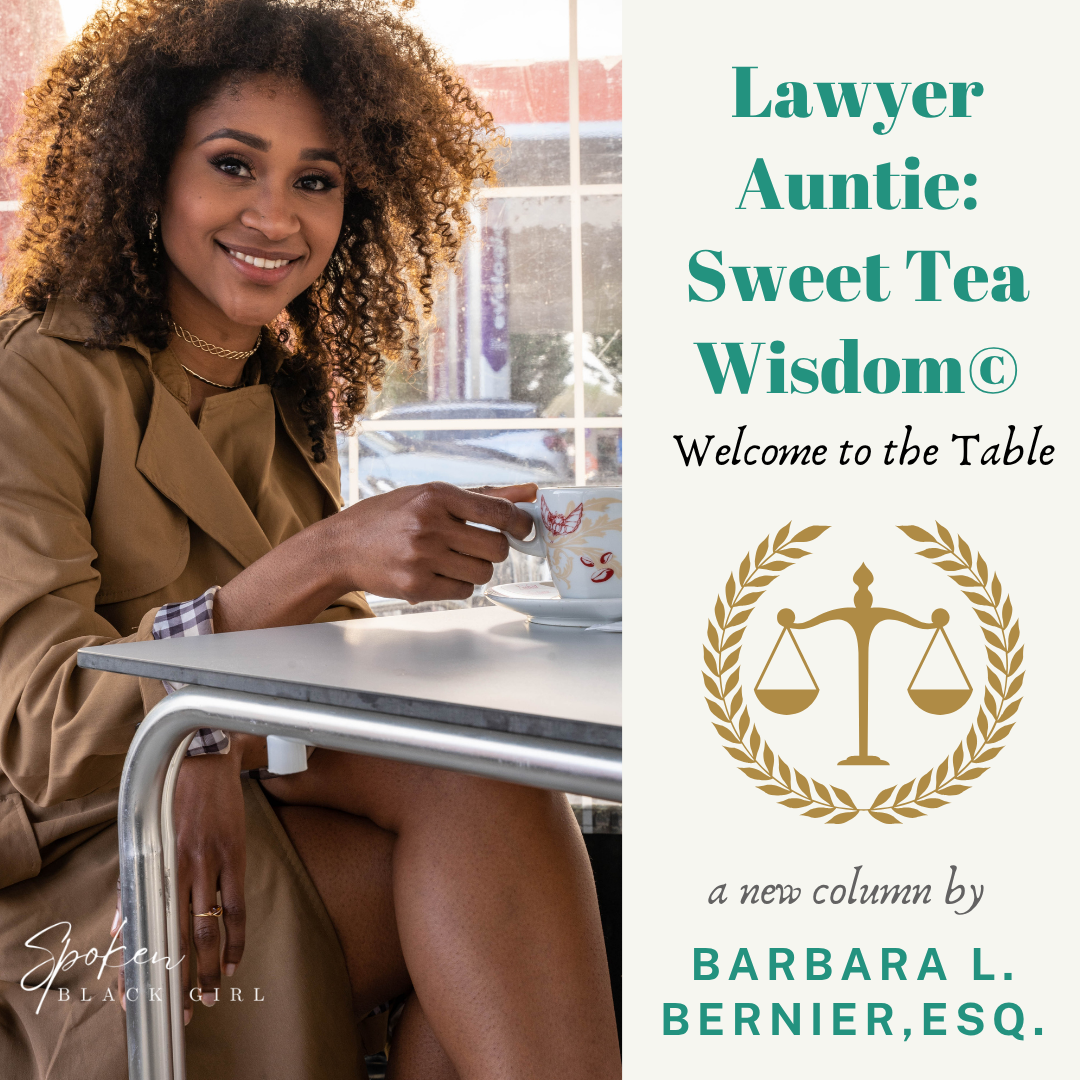
Lawyer Auntie: Sweet Tea Wisdom©
Welcome to the Table
Let’s be honest about something.
The law is not written for us. Not for Black renters trying to keep a roof over their heads. Not for young professionals signing contracts full of language that’s designed to confuse. Not for the first person in their family to walk into a courtroom – or worse, to be walked in. The law, as it has been practiced and enforced in this country, has more often been a wall than a door for Black Americans.
We saw it again this year in the Supreme Court’s decision in Louisiana v Callais — a case about redistricting and Black voting power that I discussed in my Op-Ed on June 4, 2026, in the Miami Times. The ruling reminded us, once again, that the courthouse and the ballot box have always been connected to our community. That what happens in those marble buildings reaches all the way down to which candidate appears on your ballot, which district gets resources, and whose voice gets counted.
But here is what is also true: the law is a tool. And tools belong to whoever learns how to use them. That is why this column exists.
What Legal Auntie: Sweet Tea Wisdom© Is
The Legal Tea is a legal literary column. Every issue, we’ll sit down together and talk through how a specific area of the law generally works, in plain language, with real context, and without the jargon that has long gatekept legal knowledge from communities like ours.
I will cover tenant rights and employment law, criminal justice and civil rights. Wills, contracts, family law, voting rights and your digital life. The questions you should be asking before you sign, before you speak and before you assume someone else has your interests at heart. This column draws on real fact patterns – from cases, from questions I hear from students and community members, and increasingly questions submitted by readers like you. Think of it as your brilliant older cousin or Auntie who went to law school and explained things at a family cookout. With the receipts!
What The Legal Tea Is Not
This column is not legal advice. It does not create an attorney-client relationship between us and is not a substitute for counsel when your situation calls for it.
The law is not one-size-fits-all. Your specific situation – your state, your lease, your employer, your circumstances -has variables that no column can fully account for. What this column can do is provide a roadmap. The framework, the questions that help you walk into any legal situation more informed, less alone, and a lot less easy for someone to take advantage of you. When a situation requires a licensed attorney – and I will always tell you clearly when it does – I will point you toward free and low-cost resources to find one. Because access to legal help should not depend on how much money you have.
Think of Lawyer Auntie: Sweet Tea Wisdom© as preparation, not prescription. Legal literacy as an act of self-determination.
Inaugural Column
The Paper That Protects You: Your Lawyer Auntie's Guide to Wills and Powers of Attorney

Baby, pull that chair up close, because Auntie needs you to hear this one all the way through. Nobody wants to think about sickness or dying while they're getting their edges laid and their color refreshed. Auntie understands that. Still, the women who protect their families best are the ones who plan while they feel strong, not the ones who scramble once trouble arrives.
So, let's talk about the paper that protects you.
A Story You'll Recognize
Meet Renee. Forty-three years old, running her own business, raising two teenagers, caring for her mother on the weekends. Renee always figured she had time to "get her affairs in order" - that phrase people use for something they plan to do later. Then Renee had a car accident. Nothing fatal, but serious enough to land her in the ICU for eight days, unable to speak for herself.
Her sister and her husband disagreed about her medical treatment. The hospital could not release information to family members without proper authorization. Bills piled up while no one held the legal authority to access her accounts and pay them. Renee survived, and she came home to a family still healing from a fight that never needed to happen.
Auntie tells you Renee's story because too many Black women carry the same false comfort - the belief that "later" always comes.
What the Law Actually Says
A will directs how your property transfers after you pass away. Without one, state law decides who inherits your assets, and that process rarely reflects what you actually wanted. A healthcare power of attorney names the person who makes medical decisions for you when you cannot speak for yourself. The financial power of attorney names the person who manages your money, pays your bills, and handles your property if illness or injury leaves you unable to act.
These three documents work together. A will speaks for you after death. The powers of attorney speak for you in life when moments of illness or injury take your voice.
Why This Matters More for Black Women
Black families lose generational wealth at a documented, staggering rate, and a large share of that loss traces back to the absence of a will. Research from groups tracking estate planning consistently shows that Black Americans hold wills at lower rates than white Americans, often due to historical distrust of legal systems, cost concerns, or simply never having the conversation modeled at home. That gap leaves families fighting probate court instead of grieving together, and it leaves property, businesses, and homes vulnerable to loss.
Black women carry the added weight of frequently serving as the family's primary caregiver and financial anchor. Planning ahead protects the people who depend on you.
What You Can Do Right Now
Name your healthcare decision-maker today. Choose someone who knows your values and can advocate for you under pressure, and put that choice in writing.
Draft a financial power of attorney. Give a trusted person the legal authority to pay your bills and manage your accounts if you become unable to.
Write a will, even a simple one. Naming beneficiaries and guardians for minor children removes the guesswork that tears families apart in court.
Store your documents where they can be found. Give copies to your named agents and keep the originals somewhere secure and known to your family.
Revisit these documents every few years. Marriage, divorce, births, and moves all change what your paperwork should say.
Auntie's Closing Word
Renee got better. Her family got the paperwork done the month she came home. My beautiful niece, protecting your voice while you have it is one of the most powerful things you will ever do for the people you love.
Get your papers in order. Name your people. Speak clearly today, so nobody has to guess tomorrow.
That is exactly how Auntie raised you.
Lawyer Auntie: Sweet Tea Wisdom© by Barbara L. Bernier, Esq. All rights reserved.
Q&A For Lawyer Auntie
Q: Do I need a lawyer to write a will, or can I use an online template?
A: Templates work for very simple situations. Auntie recommends a licensed attorney when you own property, run a business, or want to protect specific family members. The cost of a mistake in probate court far exceeds the cost of proper drafting.
Q: What happens if I get sick and never named a healthcare power of attorney?
A: A court may need to appoint a guardian to make decisions for you, and that person may not be who you would have chosen. Naming your own agent keeps that choice in your hands.
Q: Can I change my mind after I sign these documents?
A: You can revoke or update a will or power of attorney at any time while you have mental capacity. Auntie encourages a review every three to five years or after any major life change.
Q: My family already knows what I want. Do I still need this in writing?
A: Verbal wishes carry no legal weight in a hospital or a courtroom. Writing your wishes down protects your family from painful guesswork.
Submit your Questions
Auntie Lawyer: Sweet Tea Wisdom© belongs to this community. Submit your questions – anonymously if you prefer – to blb@barbarabernier.com. I cannot promise to answer every question individually, but the patterns I hear will shape every column I write. The courthouse has always had something to say about our lives. It is time we had something to say back.
Pull up a chair. The tea is hot!
LEGAL DISCLAIMER: This column provides general legal information for educational purposes only. It does not constitute legal advice and does not create an attorney-client relationship. Laws vary by state and individual circumstances differ. Readers facing specific legal situations should consult a licensed attorney in their jurisdiction.

Barbara L. Bernier
Barbara L.Bernier, Esq. brings years of legal practice to this column written specifically for Spoken Black Girl. She believes legal literacy is a form of empowerment and gives Black women the tools to protect their careers, their identities, and their wealth. She is a law professor at the University of Illinois and a Fulbright Specialist specializing in AI and its impact on civil rights. She can be contacted at blb@barbarabernier.com
Social Media
www.Facebook.com/BarbaraBernier
LinkedIn - https://www.linkedin.com/in/babernier?
Substack - @barbarabernier.substack.com & Turning the Light Inward (technology and Zen) & Prof.Barbara Bernier (legal issues)
Website