The Beauty Files: Julie Atkinson
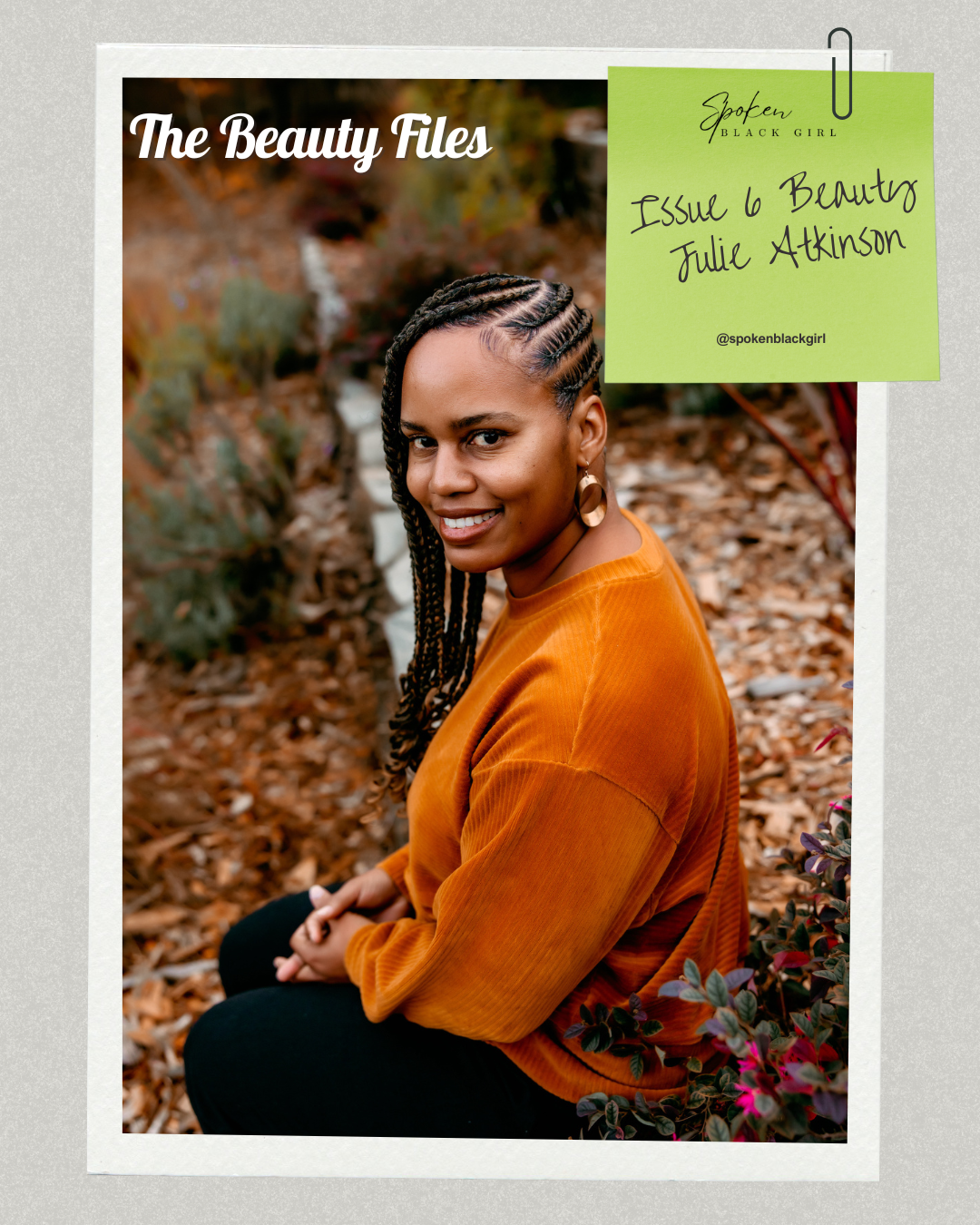
Welcome to the Beauty Files, a series where we will uncover the behind the scenes stories of our Issue 6 Beauty Contributors and what they believe about beauty as Black women artists and creatives. We’re starting with our cover artist, Julie Atkinson.
What inspired your piece featured in Spoken Black Girl: Beauty?
My work is inspired by the desire to create a place of softness, light, and healing, particularly for Black women. I am creating from the point of view of a Black woman who has grown up, lived, been educated, worked in predominantly white spaces. It can be very hard to find affirmation of your beauty and your worth when the images around you and the texts you are given to read were not actually created with you in mind. Instead, you are constantly bombarded with messages, subtle and not so subtle, that question whether you belong. My response is to do what Toni Morrison urged us to do and create the art I needed to see. I needed to see rest instead of worry, softness instead of feeling on edge.
How does your work explore or redefine beauty in your own words?
I embrace big, natural hair and the way it can be shaped. I love how our hair can hold shape on its own. I like to use softer colors because I don't know if we see Black women in soft colors enough, with that gentleness and sense of delicateness.
What does beauty mean to you today? Has that definition changed over time?
Beauty for me is freedom, its laughter, its dancing. I believe a person is at their most beautiful when they are their most authentic selves. I think when I was younger I probably thought about beauty in more traditional terms. But getting older-- I'm inching up on 50-- you do start to see things differently. Your own body changes and you have to come to terms with that. I had someone older than me describe herself as "ageless" which I love. You start to see all the complexities of life, how people handle it and realize that you find things that make you smile, make you feel warm and joyful and connected, and realize that there is true beauty in that. That's what matters.
What role has writing, art, or creativity played in your self-expression and healing journey?
It's been everything. Through painting, I can create what I need to see. I spent so many years not sure of where I fit, feeling like I was failing at jobs that I was actually trained to do. I needed to feel like I was good enough as I was. So I painted women who looked like me. I didn't know where to find them, so I made up their backgrounds. My earlier work has a more melancholic feel, I think, but it evolved to reflect more confidence, peace, and now softness. It can be hard for me to always put the feelings into words. That's why I love reading work by Black women authors so much because you stumble on a paragraph or sentence or even just a word and can be like, "yeah, what she said!" It is easier for me to think of the physical pose that reflects my feeling and try to represent that on a canvas.
Which Black woman artist, writer, or thinker has most shaped your understanding of beauty?
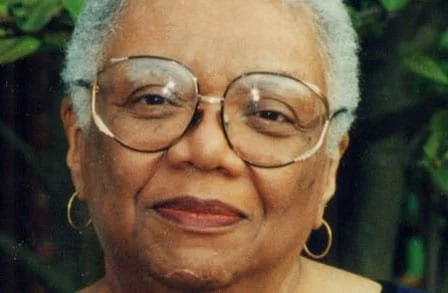
Poet, Lucille Clifton
Image Source: Getty Images
I have to say that Lucille Clifton's poetry has really spoken to me. Her work is concise and direct. I felt like she held up a mirror in front of me and made me see myself completely differently. The way her poems are phrased, it's like she's speaking to the inherent beauty in Blackness and not hearing any argument on that. For example, in her poem "what the mirror said," she opens with "listen," and then proceeds to tell you how much you are worth.
How do you hope your work contributes to the larger conversation around beauty and Black womanhood?
I think that when Black women are depicted in art, especially on a canvas in a Eurocentric culture, the conversation is changed about who is worthy of being displayed and who's beauty is being celebrated. My work surrounds Black women with softness and light. Our skin and hair are part of those things. We belong in those places too. Our beauty can be quiet and gentle. I hope my work adds yet another layer to the beautiful complexity that is Black womanhood.
What would you tell a younger Black girl about beauty that you wish you’d known sooner?
I see so much more confidence in young Black girls and women in how they present themselves than when I was their age. They have access to a far more expansive vision of beauty. I would tell a younger Black girl or woman to embrace all of that. To pour into herself, care for her mental and physical health, nurture her intellectual curiosities. Her being her most authentic self is beauty. To the younger Black girls who are growing up with few other young Black girls around them, like I did, I would say, you are beautiful and amazing, there is a whole world of Black women out here who are proud of you and ready to support you so hang in there.
What are you currently working on or excited about sharing next?
I've been working on some paintings for a series that I hope I can present as an exhibition. The theme is healing, but there is some specific imagery that I am exploring that I think will make it really cohesive. It includes pieces that feature multiple women and explore how solitude as well as community play a part in the healing process.
More About Julie:
Julie Atkinson (b. 1977) is a visual artist from the San Francisco Bay Area. Julie began painting while working as a lawyer. She learned techniques and art history through library books, online videos, and community center classes.
In 2020, Julie was inspired her to take her figurative art practice in the direction of exploring Black female identity in a way that liberates Black women from societal assumptions, reclaiming the personal from the political realm. Creating this work became an opportunity for her to exhale, heal, and imagine.
Julie’s work has been exhibited in galleries and public spaces around the San Francisco Bay Area and the country, including as part of the Black Creativity Juried Art Exhibition at the Griffin Museum of Science and Industry in Chicago in 2022.