
The Beauty Files: Chidera Udochukwu-Nduka
Welcome to the Beauty Files, a series where we will uncover the behind the scenes stories of our Issue 6 Beauty Contributors and what they believe about beauty as Black women artists and creatives. Next up we have Spoken Black Girl Beauty Contributor, Chidera Udochukwu-Nduka, whose poem “Melanin Monroe” appears in Spoken Black Girl Issue 6 Beauty.
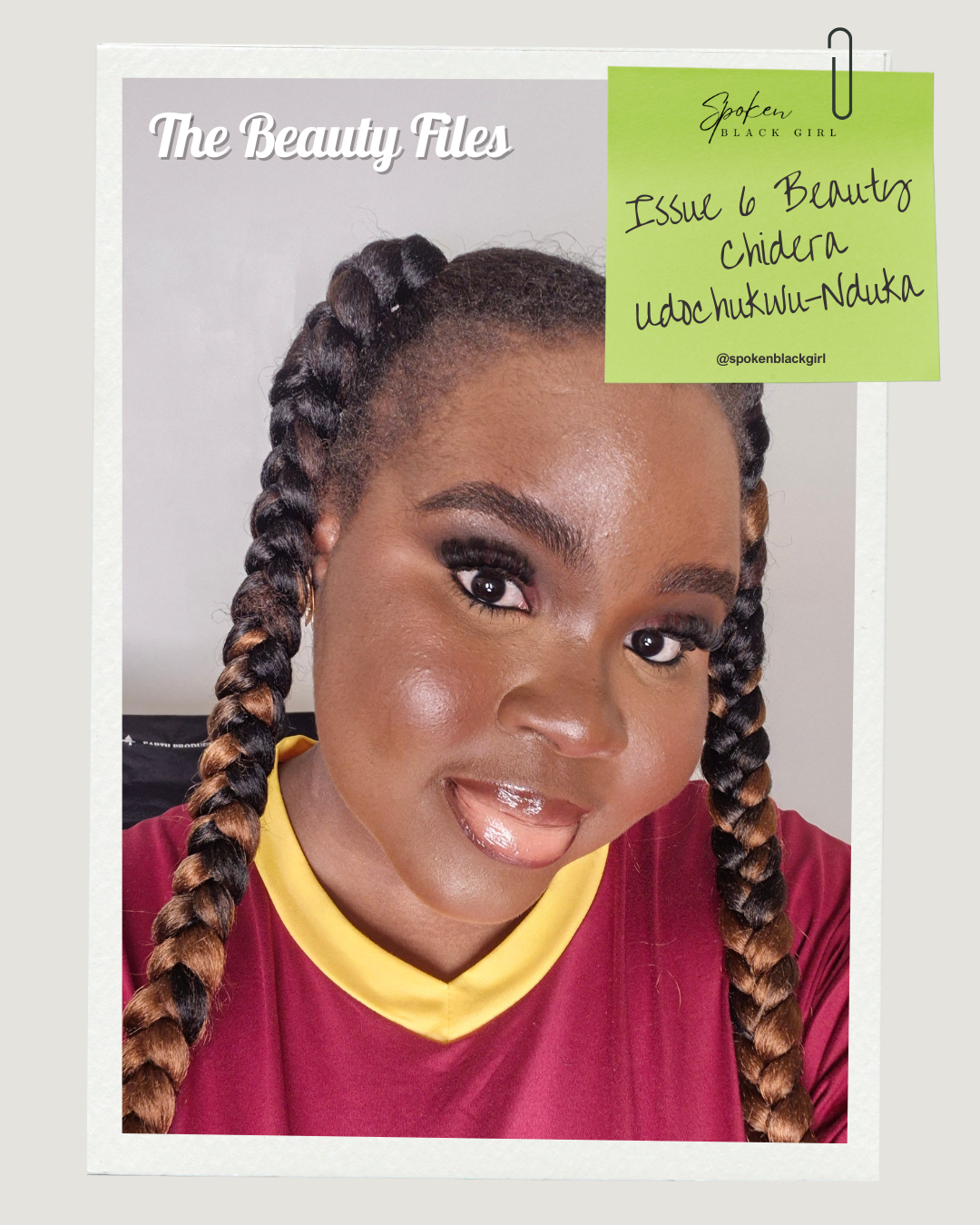
What inspired your piece featured in Spoken Black Girl: Beauty?
“Melanin Monroe” was born from a need to praise what the world once tried to dim. I wanted to write a piece that celebrated Black womanhood in all its texture — our sun-kissed skin, our ancestral hair, our curves, our power, our softness. I grew up in a world that often measured beauty through Eurocentric eyes, and this poem was my way of reclaiming the mirror, reshaping it into something that reflected me honestly.
I wrote with the intention of building an altar to our bodies — hair like lion’s manes and braids threaded with heritage, skin blessed with nightshade glow, jigida dancing at the waist. I wanted a poem that feels like cocoa butter, like morning sun, like home — something that reminds us we were crafted with intention, brilliance, and divine melanin.
In this piece, I call myself the S.I. unit of radiance, not out of arrogance but affirmation. I wanted to remind every Black girl reading: you are the standard, you are the definition, you are beauty itself.
How does your work explore or redefine beauty in your own words?
My work redefines beauty by shifting the lens back to where it belongs — on us. In “Melanin Monroe”, beauty is not passive or fragile; she is bold, brown-skinned, cocoa-sweet, clay-born, and crowns herself. I explore beauty through heritage, through the textures and tones we inherit from foremothers who existed before mirrors and still knew their worth. In my writing, beauty is carved into the curve of an afro puff, the weight of Fulani beads, the confidence of dark skin glowing like nightfall.
I wanted to push against the myth that beauty must be light, quiet, or diluted to be seen. My work says beauty is loud — she jiggles jigida beads, smells like fresh rain and cocoa butter, and walks with the rhythm of an entire continent. She is ancestry, strength, softness, rebellion, and radiance intertwined.
Beauty, in my words, is not something we chase —it is something we are.
Was there a specific moment, person, or experience that sparked your creative process for this piece?
The spark for “Melanin Monroe” came from watching how Black women, myself included, often grow into beauty rather than being handed it. I remember standing in front of a mirror one day, tracing the curl of my hair with my fingers, realizing that everything society once told me to tone down — my skin, my features, my fullness — was exactly what made me powerful. That moment of recognition became the seed.
I wanted a poem that felt like looking into a mirror that finally loved me back — a mirror that saw clay, sun, ancestry, and goddess instead of comparison or lack. I reached for images that reminded me of home and womanhood: jigida beads, mahogany hair, cocoa butter, cornrows woven like lineage. These memories guided me like a compass.
This piece was inspired by that quiet awakening — the moment I understood that my blackness is not something to defend, but something to celebrate.
What does beauty mean to you today? Has that definition changed over time?
Beauty today feels like ownership — not approval. It is the way my skin absorbs sunlight like it was born for it, the way my hair grows upward toward the heavens, the way my body carries memory, ancestry, and sensuality with no apology. Beauty is presence. It is breath. It is inheritance.
But it wasn’t always this way.
For a long time, beauty was something external, something measured, compared, graded against Eurocentric standards that never had me in mind. I thought beauty was something I had to earn. Now I know beauty is something I embody, something that existed long before I named it.
”Melanin Monroe” reflects that evolution from seeking validation to realizing I am made of clay, sun, cocoa butter, and bloodline. My definition has matured from "Am I enough?" to "I am the standard." Black, bold, divine.
What role has writing, art, or creativity played in your self-expression and healing journey?
I think of a moment in front of a mirror, not a glamorous moment, but a quiet one. My hair was freshly washed, full and untamed, curling like wild vines guided by ancestral memory. I traced the strands with my fingers, and instead of wishing it straighter, longer, or smaller, I suddenly felt awe. My hair wasn’t just hair, it was heritage. It was survival. It was beauty rooted in centuries of Black womanhood.
I felt powerful in that moment like every woman before me stood behind my reflection, nodding. Every braid, every puff, every knot carried stories. I didn’t need to fit into beauty; beauty unfurled from within me like dawn.
I felt like the S.I. unit of radiance, not simply seen, but self-defined. Not performing beauty, but becoming it.
What role has writing, art, or creativity played in your self-expression and healing journey?
Writing has always been the place where I return to myself where my voice doesn’t need permission, where beauty isn’t filtered, where my emotions can stretch their limbs without shrinking for anyone. Creativity is the language my spirit uses to speak, to remember, to unlearn, to bloom.
In “Melanin Monroe”, I wrote myself into radiance into clay, cocoa butter, lion-mane hair, into a woman who stands tall in her skin. Every line became a salve to the parts of me that once tried to blend in. Through poetry, I learned to celebrate what I once softened and to embrace the richness of my darkness, my African femininity, my ancestral inheritance.
Art makes me whole. It turns wounds into ink, memory into metaphor, girlhood into goddesshood.
Creativity is how I heal and healing is how I shine
Which Black woman artist, writer, or thinker has most shaped your understanding of beauty?
Toni Morrison’s voice reshaped the way I see myself as a Black woman. Her words taught me that beauty is not something we must chase, it is something we declare, embody, and remember. In her work, Black women do not shrink; they expand. They take up space like oceans. They exist outside comparison, outside permission, outside the gaze that once tried to define them.
Reading her reminded me that my skin, dark as fertile earth carries history, softness, rage, tenderness, and brilliance without contradiction. She showed me that beauty is not performance; it is inheritance, a birthright that lives under the skin like light.
Morrison gave me language for my reflection. She taught me that beauty is not compliance —
beauty is sovereignty, ownership, becoming.
Her work is the mirror that taught me to love my own.
Which Black woman artist, writer, or thinker has most shaped your understanding of beauty?
Melanin Monroe was shaped by sound, rhythm, and image, art that carried the heat and softness of Black womanhood. I wrote while listening to the soulful hum of Solange, the confidence of Beyoncé’s Brown Skin Girl, the afro melodies of Wizkid celebrating melanin, and the honey-rich elegance of SZA. Their music reminded me that Black beauty has bass, it vibrates, it breathes, it glows.
Literature also held my hand through the process. Toni Morrison’s The Bluest Eye and Warsan Shire’s poetry unlocked something in me, a knowing that our stories don’t need justification to exist. They taught me to love the nightshade hue of my skin, the depth of my lineage, the weight of my power.
Visually, I returned to the art of Yinka Shonibare and Laolu Senbanjo — vibrant patterns, Yoruba cosmology, body as canvas. Their work helped me see beauty as ritual, as resistance, as radiance.
The poem became a collage of all these influences, sound, heritage, imagery, and a heartbeat of Black pride
How do you hope your work contributes to the larger conversation around beauty and Black womanhood?
I hope “Melanin Monroe” stands as a love letter not just to myself, but to every Black woman who has ever doubted her glow. When I wrote this poem, I imagined it as a mirror polished with truth, reflecting back the fullness of our beauty: skin rich as earth, hair crowned like royalty, hips that sway like rhythm itself. I want this piece to remind Black women that we are not alternatives or afterthoughts, we are origin. We set the tone. We are the blueprint.
In a world that often misinterprets, minimizes, or markets our beauty back to us, I want my work to speak with clarity: we do not need permission to shine. Our melanin is not something to edit. Our history is not something to soften. We are art, architecture, ancestry living proof of resilience and radiance intertwined.
If my poem encourages even one Black woman to stand taller, love deeper, or take up her space without apology, then it has done its work.
What would you tell a younger Black girl about beauty that you wish you’d known sooner?
I would tell a younger Black girl: “Dear Queen, you’ve got a crown that you can’t put down.” In other words, never let anyone tell you that you’re not worthy or allow you to forget your worth. You deserve all of the happiness and peace that your heart desires. Be your authentic, beautiful self, because there is no one else in the world like you.
What are you currently working on or excited about sharing next?
Right now, I am creating work that continues to celebrate Black womanhood, memory, and the spiritual pulse of ancestry but with new layers of magic, tenderness, and rebellion. I’m writing poems that feel like thunder in the chest, stories soaked in moonlight and folklore, pieces that speak to healing as both softness and strength. I want my next work to walk barefoot through history and still stretch its hands toward the future.
I’m also exploring longer projects, collections that weave together identity, heritage, and the electric power of womanhood. I am excited to share work that feels like homecoming, like unlearning and returning, like discovering your beauty for the first time and again and again.
Whatever comes next, I want it to remind Black women that we are galaxies expansive, radiant, impossible to dim
More About Chidera:
Chidera Udochukwu-Nduka
Chidera Udochukwu-Nduka is a Nigerian-Igbo writer, creative professional and pharmacist. Chi Deraa won the second prize in the 2024 Dissolution Climate Change Essay Contest organized by Litfest Bergen Norway and first prize in the Letters Category of the 2025 LIGHT Trust Issue. She was a runner-up in the 2024 South African Bloody Parchment Horrorfest competition. She is a recipient of the Illino Media Writing Residency. She was shortlisted for the 2024 AKACHI CHUKWUEMEKA PRIZE FOR LITERATURE. She also won second and third prize in the 2023 and 2024 AS ABUGI PRIZE and second prize in the 2024 IKENGA SHORT STORY PRIZE. She was a finalist in the 2024 K&L PRIZE FOR FICTION and the 2023 E.C MICHEALS SHORT STORY PRIZE. She took the third position in the 2023 BKPW Poetry Contest. She was also shortlisted for the 2023 The Green We Left Behind CNF contest organized by the Arts Lounge Literary Magazine. She won the 2022 Shuzia Songs of Zion Poetry Contest, the 2022 Shuzia Prose Contest. She won first runner-up in the prose category at the 2022 Lagos Hilltop Creative Arts Foundation contest. She also won the 2021 UNIZIK School of Pharmacy Poetry Contest. She is a contributor/ forthcoming at Midnight and Indigo, IHRAF Thorn, Tears, and Treachery Anthology for the Sudanese War and Invisible Chains – Stories of Migrants, Libre Lit, Akpata Magazine, Aprilcentaur, Mythic Picnic, Feminists in Kenya, Lagos Review, Non-Profit Quarterly Magazine, Love and Other Stupid Things Anthology, Fortunate Traveller, Indaba Bafazi SFF Anthology, PIN Best Poems of 2024 Anthology, 2022 Chinua Achebe Poetry/Essay Anthology, Conscio Magazine, Ngiga Review, World Voices Magazine, Valiant Scribe, Arts Lounge Literary Magazine, amongst others.
Social Media:
queenderaa001 @ Instagram, chi_deraa001@ Twitter
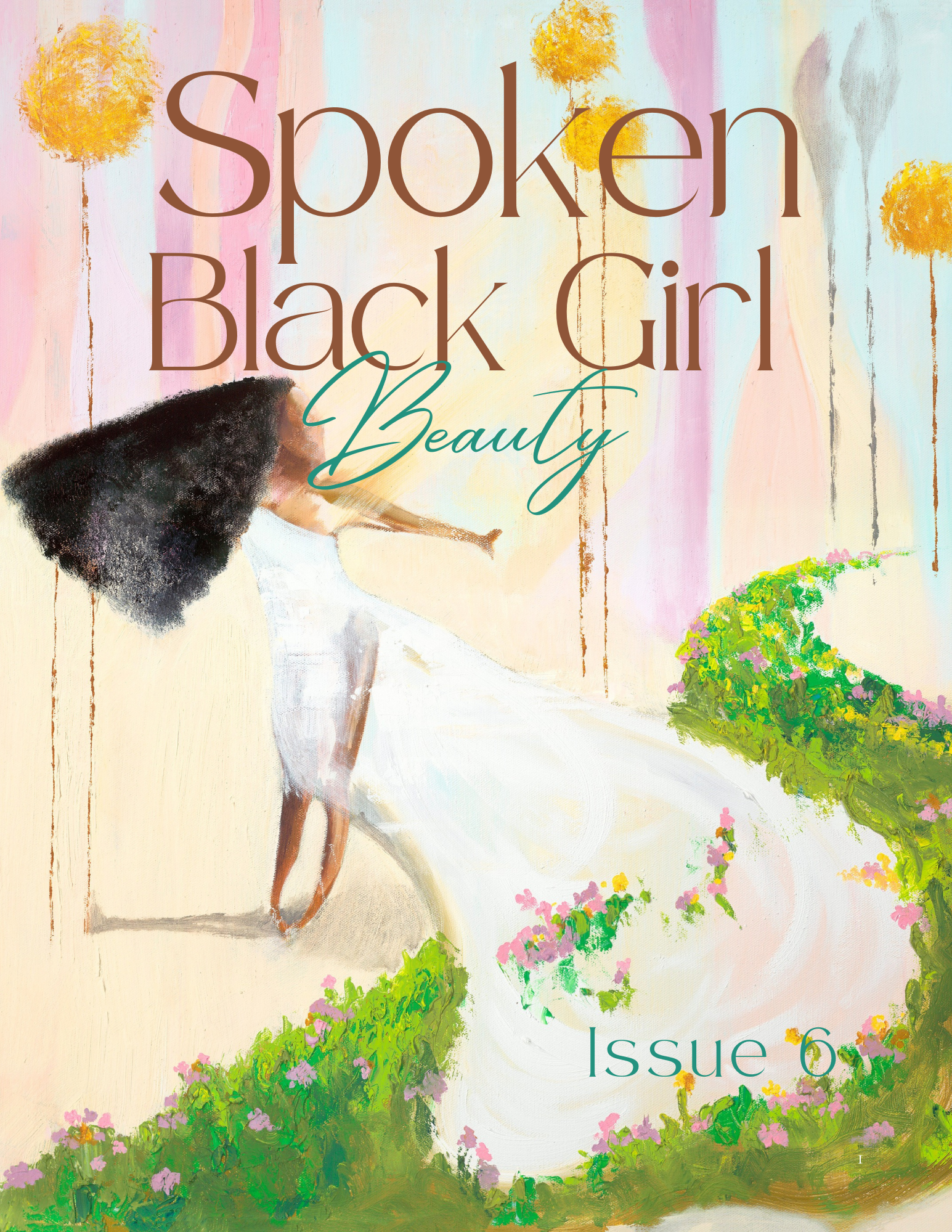
Spoken Black Girl Magazine: Issue 6 – Beauty is a radiant, full-color exploration of Black beauty rooted in self-love, authenticity and community. Weaving compelling mental health narratives with poetry and stunning visuals, Spoken Black Girl Issue 6 Beauty contains works that redefine beauty. Written, edited and curated by Black women and femmes, Spoken Black Girl Beauty offers a unique editorial viewpoint in which our beauty is the standard. Our Issue 6 cover features Solitude by Julie Atkinson.
Featured Issue 6 Beauty Contributors:
Adwoa Amponsah, Yewande Akinse, Julie Atkinson, Maroula Blades, Daisy Brown, Christie A. Cruise, Jada D'Antignac, Daniela Dampare, Kamaria Delaney, Elizabeth DeHaan, Crystal Foretia, Salisa L. Grant, Brandon LA Hutchinson, Yuki Jackson, Rev. Lotus La Loba, Michaela "Mikki" McKenzie, Brittney Miles, Amari Murray, Traci Neal, Adrienne Prather, Khalisa Rae, Karla M. Scipio, Kayla T., Chidera Udochukwu-Nduka, Afton Williams-Jacobs, Jasmine Williams-Jacobs, Maya Williams
Issue 6 Editors:
Editor-in-Chief: Rowana Abbensetts-Dobson, Guest Editor: Emelda De Coteau, Guest Editor: Jana Jones.
Highlights include:
✨ New contributor features alongside beloved returning writers and artists
🌿 The launch of the Spoken Black Girl Community Awards
💖 Resources on Safe Beauty Without Compromise
🎨 Full-color artwork that celebrates the brilliance of Black womanhood
Whether you’ve followed Spoken Black Girl from the beginning or are just joining our community, I hope you enjoy this issue.
All preorders will come with a special gift and be signed by Spoken Black Girl Editor-in-Chief, Rowana Abbensetts-Dobson
Publication Date: February 2, 2026
Format: Full-Color Print & Digital Edition
Publisher: Spoken Black Girl Publishing
Preorder now to reserve your copy and be part of this celebration of Black beauty and storytelling.
Full-color print copy of Spoken Black Girl Magazine: Issue 6 – Beauty
Ships in eco-friendly packaging with literary thank-you gifts inside
Publication Date: February 2, 2026
🌸 Every Purchase Supports
Your order helps Spoken Black Girl Publishing continue uplifting the voices of Black women writers and artists through storytelling, community, and healing.
