
The Beauty Files: Kayla T.
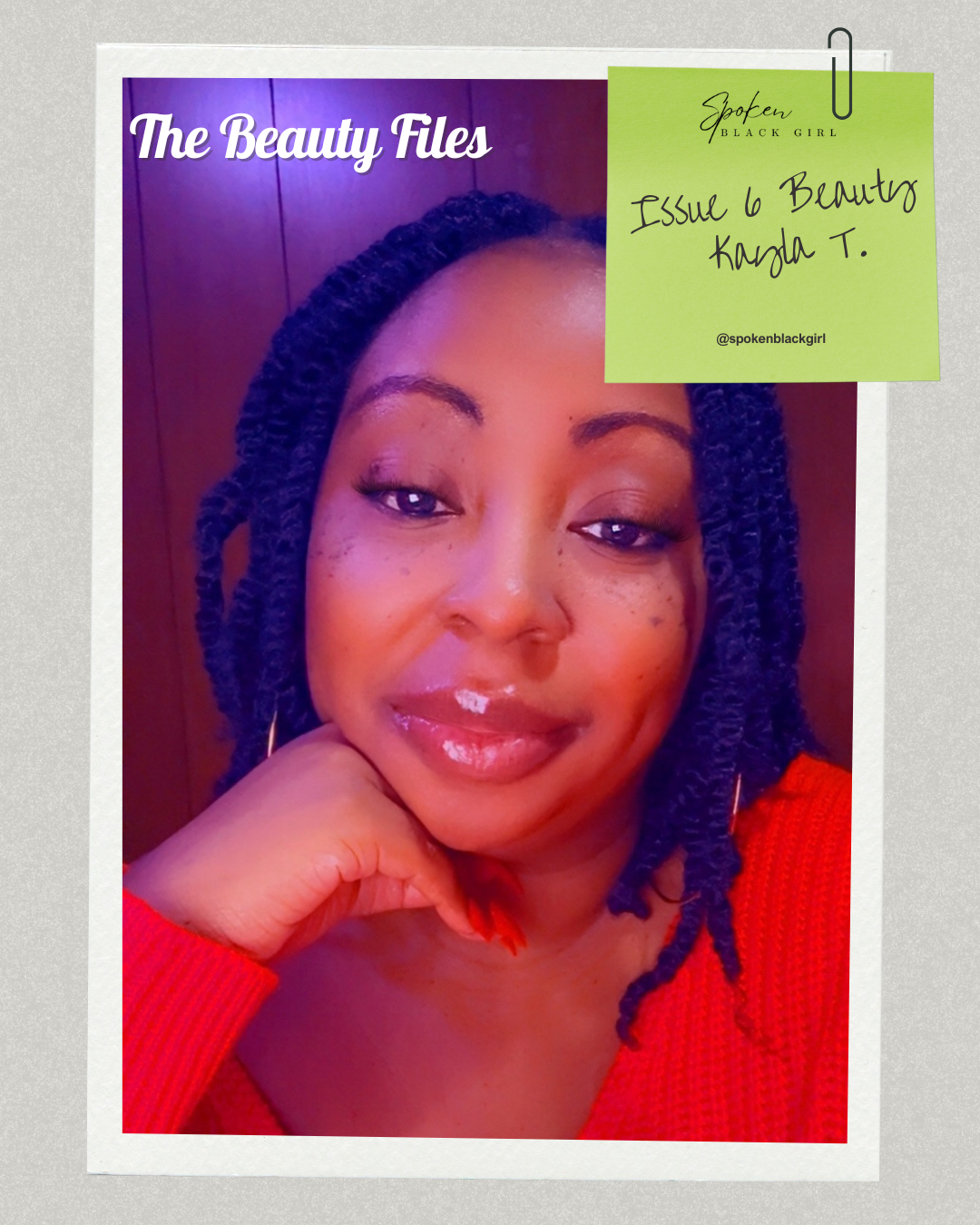
Welcome to the Beauty Files, a series where we will uncover the behind the scenes stories of our Issue 6 Beauty Contributors and what they believe about beauty as Black women artists and creatives. Next up we have Spoken Black Girl Beauty Contributor, Kayla T, whose essay “Seeing Me: Skin, Legacy, and Liberation” appears in Spoken Black Girl Issue 6 Beauty.
What inspired your piece featured in Spoken Black Girl: Beauty?
Honestly, I wrote this as a full circle moment. As a teenager, I felt beautiful without needing to prove it. Growing up in NYC, I was always in a melting pot of unique beauty. I wasn’t consumed by comparison or image. I was surrounded by love and allowed to just be. But adulthood came with new pressures—ways the world tried to reshape how I saw myself. An awakening of my Blackness through other people’s eyes. Somewhere along the way, beauty started to feel like something to maintain, defend, or earn.
Now, as an adult who has lived through multiple heartbreaks from romantic love, platonic love, and grief, it’s a soft return to the truth: that our beauty is woven into our presence, our roots, and our becoming. Time in this world can make a Black woman’s love waver, but this piece is a reminder that we deserve to feel good in our skin, with or without the world’s validation.
Was there a specific moment, person, or experience that sparked your creative process for this piece?
A few days before writing this piece, I had an interaction with a young sista who looked at me and said, “You have a soft energy about you.” That moment really stayed with me. It was layered—because as Black women, we’re so often seen as strong, judged by how we look, or oversexualized. But this moment wasn’t about how I looked. It was about how I made her feel.
It reminded me how rare and beautiful it is to be seen in that way. Not for performance, not for perfection—but for presence. It’s funny because men often think we’re trying to be beautiful for them. But truthfully, that’s not what’s at the forefront. We want to be embraced as we are. Not judged. Not praised. Just seen.
Mental health takes a hit when the world chips away at you over time. And not everyone recovers from that. That moment made me want to write from a different place—from our energy from our roots, from our innocence—not just from what we present. I wanted this piece to remind us that beauty isn’t about how we show up. It’s the quiet impact we leave behind, the softness we carry, and the way we affirm each other without even trying.
What does beauty mean to you today? Has that definition changed over time?
Beauty today feels more like imperfection—in a good way. I’m attracted to it. It’s the raw truth, the intentional moments, the feeling of presence. Has my definition changed over time? Absolutely. I never chased beauty in a traditional way, until I got older and the world said perfectionism was part of being beautiful. I chased it in a controlled way—because the world teaches Black folks that we have to be twice as good just to be seen, let alone valued.
Now, beauty is rooted in how I care for myself, how I hold space for others, and how I move through the world with integrity and love. As a mental health coach, I get to affirm Black folks daily—reminding them that they’re not behind, not broken, not in need of fixing. They are beauty. They are enough. Not because of what they do, but because of who they are.
How do you hope your work contributes to the larger conversation around beauty and Black womanhood?
I want to disrupt the idea that we have to be perfect to be seen or palatable to be beautiful. My work is about offering mirrors where Black women and girls can see themselves and say “I am enough just like this.” But that kind of seeing doesn’t happen in isolation. It starts with self-love and is sustained through community care. We’ve inherited messages that told us to shrink, perform, or overdeliver just to be worthy of attention. But beauty isn’t something we earn—it’s something we reclaim. It lives in our truth-telling, our softness, our boundaries, and our ability to hold space for one another without shame. I hope my work invites more of us to come home to ourselves to feel seen not because we fit the mold, but because we finally broke free from it.
What would you tell a younger Black girl about beauty that you wish you’d known sooner?
Anytime the world feels heavy; and it will, because they’ll try to chip away at who you are as a Black girl growing into a Black woman—return to love. Keep love at your center. Let it anchor you when everything else feels loud. You’ll fall in and out of love with yourself. That’s human. That’s part of it. But on the hard days, if you can choose to love yourself through the mess, the heartbreak, the doubt—that’s where the beauty is.
Beauty isn’t about being perfect or palatable. There will be times you’re overlooked or made to feel like too much and not enough at the same time. But the truth is: you were never the problem. Mess up. Ask for help. Protect your mental wellbeing with the same tenderness you offer others. You’re allowed to rest. You’re allowed to come undone. You’re allowed to come back to yourself, over and over again.
Your softness is not a weakness. Your strength is not your job. Your joy is not a threat. Your fullness is not too much. If no one has told you: your beauty isn’t up for debate. It was never something to earn. It was always yours.
What are you currently working on or excited about sharing next?
I’m really excited about a few things right now. I’m working on community mental health and self-love projects that aren’t traditional. For too long, healing spaces have offered the same tools, but wellness is not one size fits all. I want to shake it up a bit.
One experience I’m especially looking forward to sharing is called Letters to My Ex. It’s a letter-based healing workshop designed to help Black folks release what they’ve been holding onto. It blends storytelling and emotional reflection in a way that honors closure, self-love, and the parts of ourselves we thought we had to lose in old versions of love. What if we didn’t need to lose those pieces at all, but could touch them again and make them whole? I’m excited to bring that into the world soon.
More About Kayla:
Kayla T. is a Certified Mental Health Coach, Emotional Wellness Facilitator, and the founder of Broken Hearts Restored, a nonprofit dedicated to making healing feel safe, accessible, and culturally grounded for the Black community. Through her work, she creates restorative, creative spaces that center emotional safety, destigmatize mental health, and honor community as a sacred site of care.
Kayla’s work lives at the intersection of mental wellness, self-love, and storytelling. Whether she is guiding emotional release through reflective letter-writing, curating self-love experiences, or writing from a place of deep truth, her intention remains the same: to help Black people reconnect with their voice, their softness, and their right to be seen.
She is also the founder of Pretty Entrepreneur, a creative brand supporting passion-driven entrepreneurs in bringing their visions to life with clarity and intention. Her commitment to this work is rooted in legacy, lived experience, and a belief that healing should feel human and culturally familiar. Her writing is where softness meets truth — and where survival is gently transformed into self-compassion.
Website:
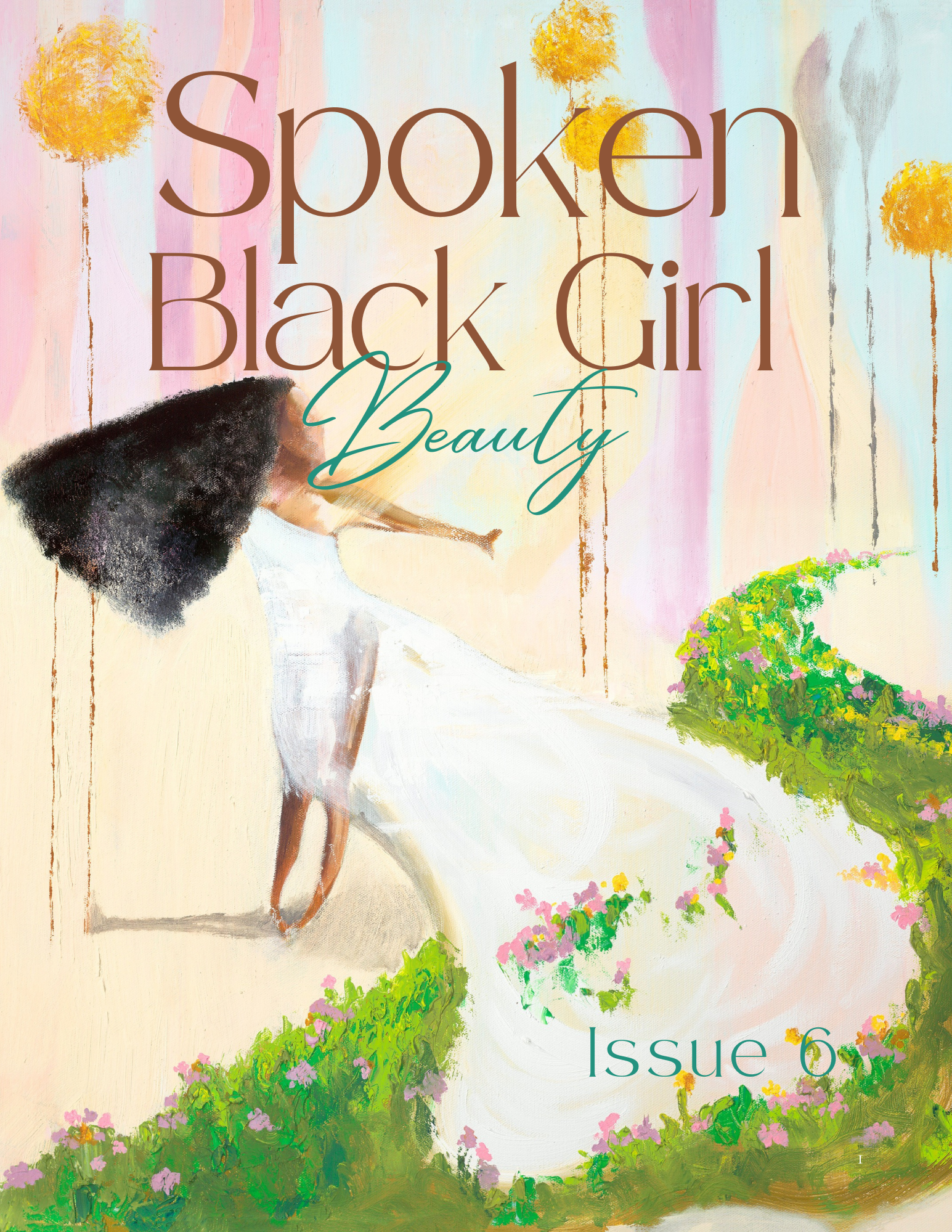
Spoken Black Girl Magazine: Issue 6 – Beauty is a radiant, full-color exploration of Black beauty rooted in self-love, authenticity and community. Weaving compelling mental health narratives with poetry and stunning visuals, Spoken Black Girl Issue 6 Beauty contains works that redefine beauty. Written, edited and curated by Black women and femmes, Spoken Black Girl Beauty offers a unique editorial viewpoint in which our beauty is the standard. Our Issue 6 cover features Solitude by Julie Atkinson.
Featured Issue 6 Beauty Contributors:
Adwoa Amponsah, Yewande Akinse, Julie Atkinson, Maroula Blades, Daisy Brown, Christie A. Cruise, Jada D'Antignac, Daniela Dampare, Kamaria Delaney, Elizabeth DeHaan, Crystal Foretia, Salisa L. Grant, Brandon LA Hutchinson, Yuki Jackson, Rev. Lotus La Loba, Michaela "Mikki" McKenzie, Brittney Miles, Amari Murray, Traci Neal, Adrienne Prather, Khalisa Rae, Karla M. Scipio, Kayla T., Chidera Udochukwu-Nduka, Afton Williams-Jacobs, Jasmine Williams-Jacobs, Maya Williams
Issue 6 Editors:
Editor-in-Chief: Rowana Abbensetts-Dobson, Guest Editor: Emelda De Coteau, Guest Editor: Jana Jones.
Highlights include:
✨ New contributor features alongside beloved returning writers and artists
🌿 The launch of the Spoken Black Girl Community Awards
💖 Resources on Safe Beauty Without Compromise
🎨 Full-color artwork that celebrates the brilliance of Black womanhood
Whether you’ve followed Spoken Black Girl from the beginning or are just joining our community, I hope you enjoy this issue.
All preorders will come with a special gift and be signed by Spoken Black Girl Editor-in-Chief, Rowana Abbensetts-Dobson
Publication Date: February 2, 2026
Format: Full-Color Print & Digital Edition
Publisher: Spoken Black Girl Publishing
Preorder now to reserve your copy and be part of this celebration of Black beauty and storytelling.
Full-color print copy of Spoken Black Girl Magazine: Issue 6 – Beauty
Ships in eco-friendly packaging with literary thank-you gifts inside
Publication Date: February 2, 2026
🌸 Every Purchase Supports
Your order helps Spoken Black Girl Publishing continue uplifting the voices of Black women writers and artists through storytelling, community, and healing.
