Healing Mixed With Humanity: What's Really Happening at Protests in New York City?
*names have been changed to protect witnesses’ right to feel safe from police retaliation.
*Martin, an essential worker, a resilient Black man, and a friend of mine, can’t talk right now. His voice has broken down from the events that took place over the last couple of days. He’s attended protests almost every night since the murder of George Floyd at the hands of Minneapolis police officer Derek Chauvin. Tuesday, while leaving me a voice message, his voice cracked and could barely make it through a sentence or a laugh as he felt the need to share one moment of positivity with me. “Yo, so this is the story...” He has sent me pictures of punctures and bruises on his body, yet sat in the hope of one moment when a cop gave him a smile instead of a ticket as he raced down the highway to his essential job in the medical field. From the medical field to the battlefield, this week hasn’t been easy for anyone. I understood what it took to sit in hope instead of despair. Currently, one of my hands hurts, I think I’ve been clapping too hard, and my ankles hurt from tripping and running from the cops. I’ve attended peaceful protests and aggressive demonstrations, but the only difference lies in what the police chose to do to us on that day. Videos and pictures of protests in New York City circulate telling one side of the story, but there are things that pictures can’t tell you. No matter where you are, we, people of color, who have witnessed police brutality since before we could catch it on camera, are all doing the same work. This is the work of sitting in hope rather than sitting in hate, the work of clinching our hearts to resist against numbness, and the work of healing through action. And it is, in fact, hard work.
It’s May, 2020, and two wars are happening on American soil. One battle started in 2019, and we call it Covid-19, the other started over 400 years ago. Covid-19 was rapidly making its way through the Black community at disproportionate rates, but Ahmaud Arbery, Tony Mcdade, and Breonna Taylor did not die because of Covid-19. Tony was gunned down, walking down the street. Arbery was hunted while taking a social distance jog. Breonna was staying home and trying to stay safe when the police took her life without question. George Floyd was making an essential trip to the grocery store. 400 years of systematic racism, racial inequality, and white supremacy have proven to be just as deadly as Covid-19. Or even more, knowing the trauma of fearing for your life could be a part of your casual daily activities.
The Numbness
On Monday, May 25th, 2020, the events in the world had already been overwhelming, I already felt numb. While hiding under the covers, I thought about how I stayed home to stay safe for months with no desire to disrupt. However, that night I had to contemplate, ‘what if I followed all the rules and my life still ended in my home?’ Would they read my diaries for all the evil thoughts I’ve had? Will the news criminalize me by holding up my one unpaid fare evasion ticket? Would they disdainfully announce I started hoarding rent money from my landlord when I saw our country’s leaders mishandling Covid-19 again? With no job to go to, I spent more time on social media, Facebook reminded me of moments from my childhood, and I realized it had been eight years since the murder of Trayvon Martin. He had no justice; we had no peace. Instead, I felt numb. I drew back, realizing I would never have time to properly mourn or memorialize every Black death by a police officer before I had another name to uphold. I let the numbness take over for eight years. That day I fought through it. I let the names of the fallen slip through my lips. It surprisingly fueled me to put on a t-shirt and leggings and jog around the block. This was the first of many protests I didn’t expect to see myself participating in the week George Floyd was murdered in Minneapolis, Minnesota, on Monday, May 25th, 2020.
I’m not the only one battling a sense of numbness and desensitization in the face of constant police brutality. *Athena is a 26-year-old Brooklyn based Black educator who has attended 4 protests over the last 2 weeks who also had to recognize her numbness, “I’m in shock, which means that I don’t feel pain and I don’t feel sad, so it’s like, not that I’m not horrified. But that the horror is so abject that I no longer experience it the way that you’re supposed to experience it. Like there. You have to numb yourself.” Over a Zoom call, I connected with Athena to talk about what’s really happening at protests in Brooklyn as people become confused about who’s inciting violence and how peaceful protests turn into acts of rage. “My experience at each of those protests was entirely peaceful. And then some outside introduction of just confusion. Suddenly you hear, you know explosions, and people begin running, and then you’re getting text messages from people saying that they’re making arrests.” According to The New York Times, over 2000 people have been arrested with charges related to protests.
Despite Athena relaying that her peaceful protests have been ransacked by a violence-inciting police force, and admitting to lasting trauma from the last few days, she says there is a sense of accomplishment. After assisting in blocking police force from kenneling people on the Manhattan Bridge, she says after seeing pictures of the people who benefited from her acts of protests, “it really meant a lot to realize that I was a part of some broader apparatus.” Sometimes organizing is resisting against numbness.
The Work
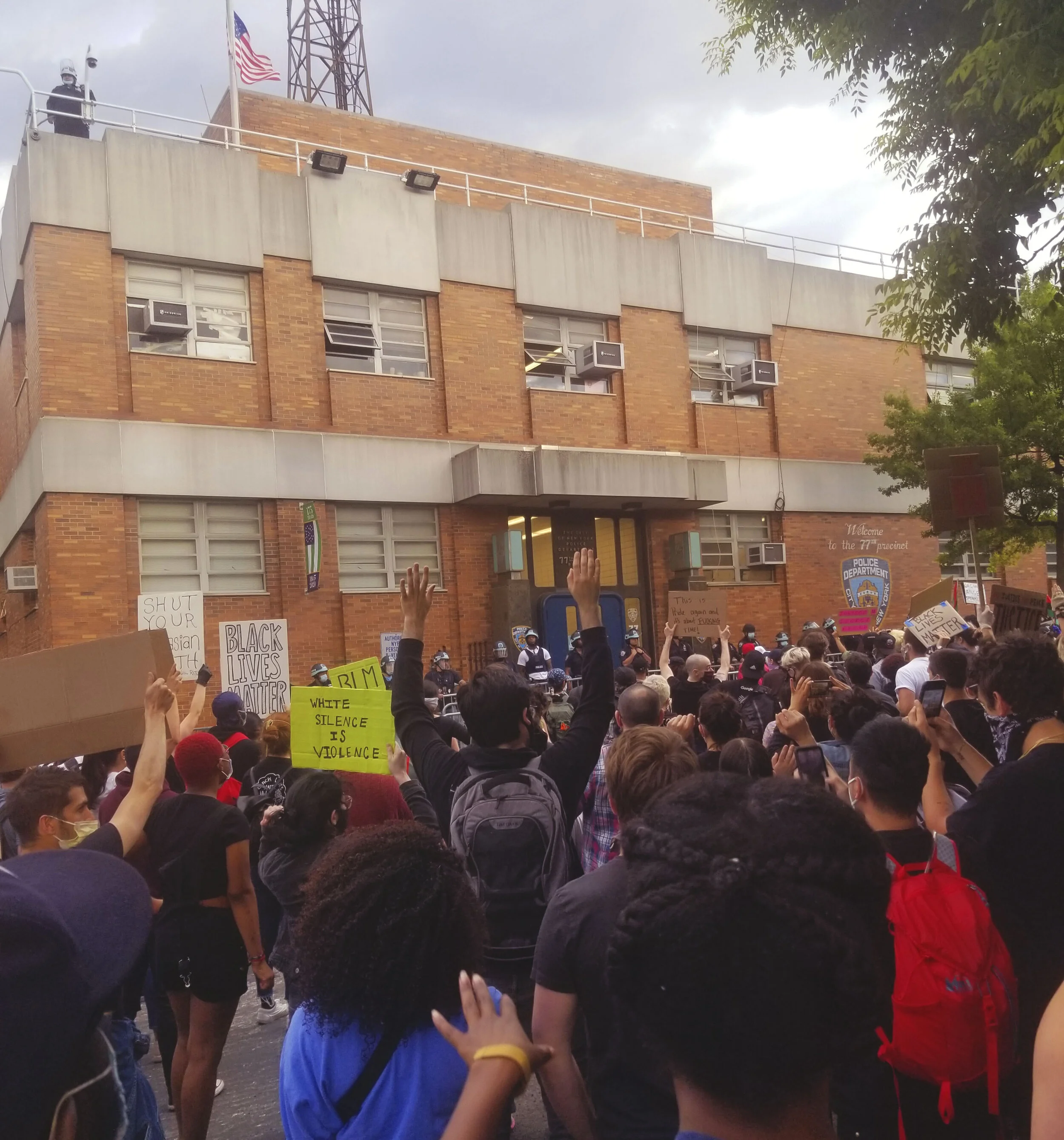
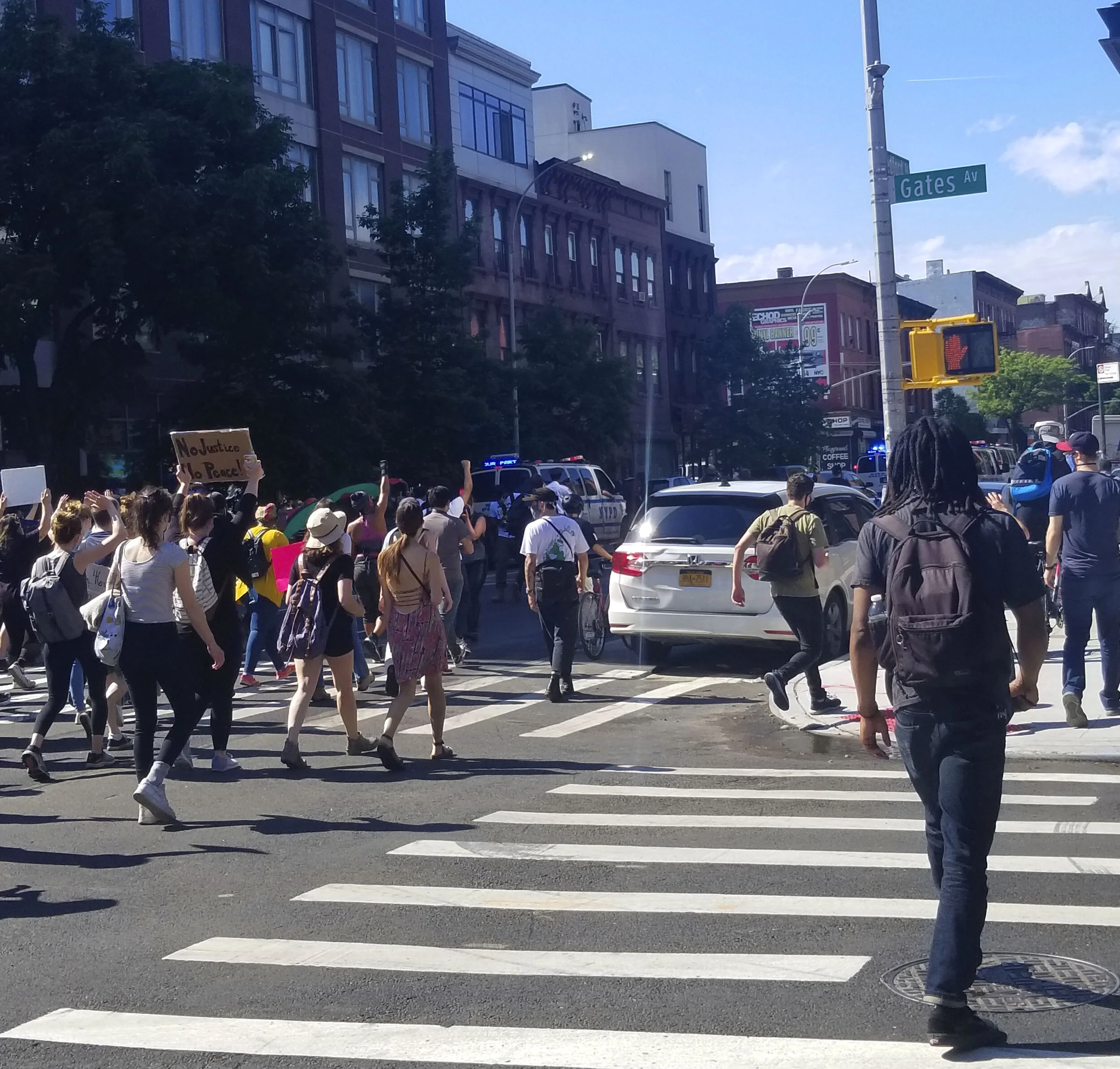
Marching through the streets of Bedstuy and Crown Heights Brooklyn Monday a week after the murder of George Floyd, I saw a man do the work. We walked through the traffic of Atlantic Avenue, one of the busiest highways by my apartment to make people pause. We needed to make people pause and look at us, we needed people to hear our cries for humanity. We ended up at the 77th NYPD Precinct. A diverse force of people chanted, “Defund the police,” and a chorus of us shouted out. “Black lives matter,” Our leaders’ voices rang through the megaphones. Walking gives you a chance to feel your emotions in a world that has almost desensitized us to our own pain.
I’m not the only one who was able to sense my emotions that day. After “Hands up don’t shoot,” cries in a small pool of people turned into “SHOOT BACK,” spitefully directed at the police officers in front of us. The officers guarding their precinct heard “hands up don’t shoot, shoot back,” The protest organizers had been unwavering in our plan to not entice violence. But who was I to tell this group of Black men to calm down? As a woman, I know “calm down,” is the easiest way to dismiss my pain and tell me I am wrong to have a human response to reality. How do I say to a man crying “shoot back” at a group of NYPD officers who are laughing while preparing to have a reason to use excessive force to calm down. An older man, with a hunched back slowly, moved his way to the leader of the “SHOOT BACK” chants. He threw his arms around the instigator like a protective field and embraced him. The older man held him tightly and whispered words in his ear that I can only guess were from a reservoir of love. As I saw the NYPD officers unclutch their weapons. I wondered, did they bank on us not being able to tap into love that day?
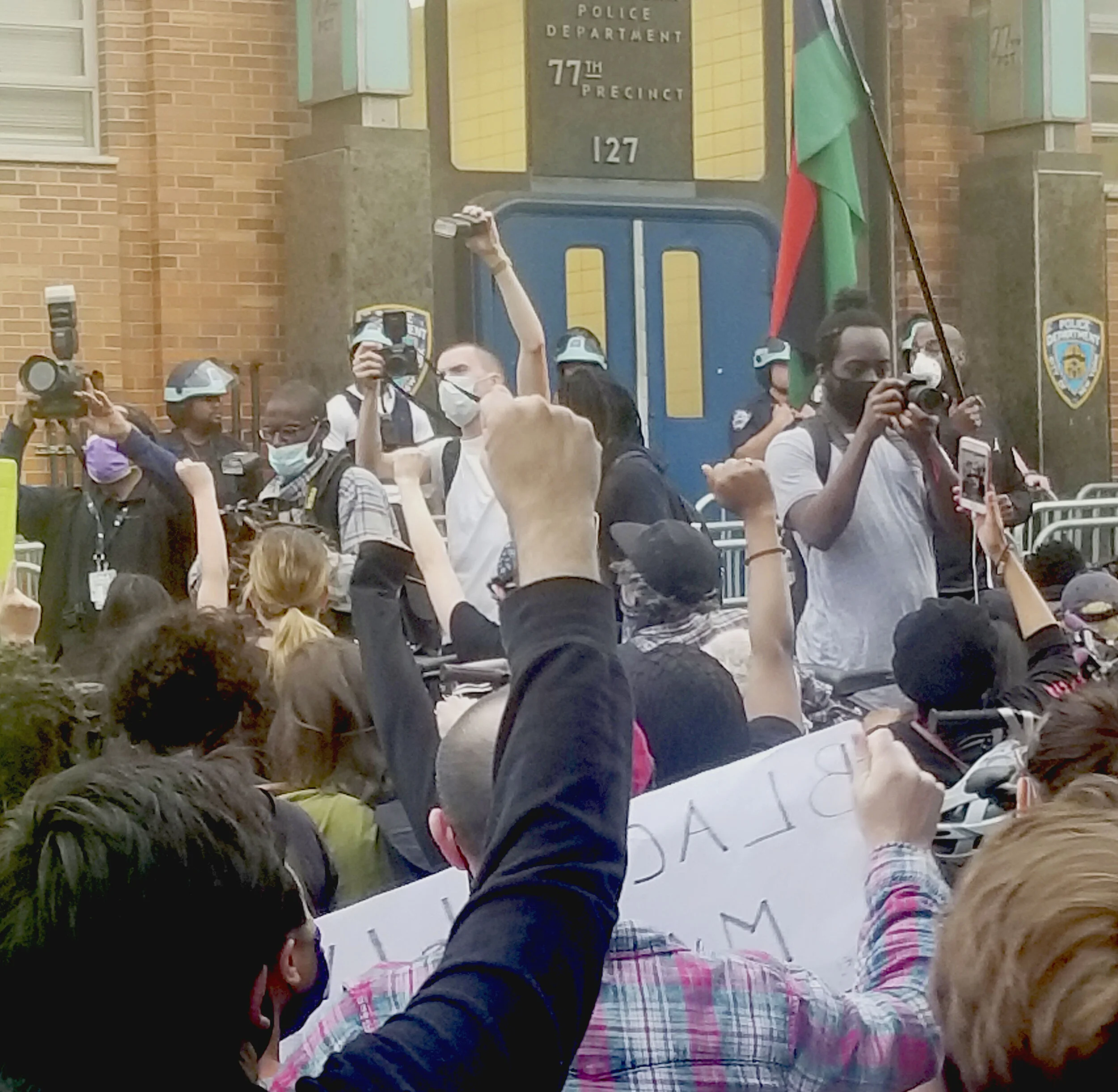
Determined to see first hand what major news organizations weren’t saying about New York City protests, I realized I couldn’t see everything by myself. I took the time to link up with *Brayton, a 23-year-old man homegrown in the Bronx, who describes his relationship with the NYPD as “fractured.” Brayton recalled his last few nights that, to some, might sound like a description of a dystopian fiction novel. “They led us into Canal Street and Soho, and they split up the group, and it was literally like hunting,” He said. “Sunday night was the first time I’d seen like acts of terrorism committed by NYPD.”
Brayton hasn’t admitted to looting himself but says, “People are looting areas that have profited off of Black lives, destroyed Black culture, and you know, remain silent during times of human unrest.” The act of reporting on looting has almost just been a tactic to further discredit the pain of Black people. When addressing how the media has portrayed the looting, Brayton went on to proclaim, “the governor and the mayor’s like, ‘why are you destroying Soho, why are you destroying Times Square, like, that’s your community?’ Why are you destroying your community? And it’s like [Coumo and De Blasio] weren’t saying anything when these communities were getting heavily gentrified, and people were getting pushed out by predatory landlords and rising rents.”
From Manhattan back to Brooklyn, I felt like the NYPD were relying on our pain as an excuse to wield their weapons. Validation and humanity have yet to be a fully integrated parts in New York Cities so-called “community policing.” I am a person who, on most occasions, is soft-spoken. My first defense to pain, sadness, and anger is silence. There are others whose first defense is just different than mine, and they are people too. Maybe even the greatest of people because they, when I pushed my emotions away, in a world that robs Black men and women of their humanity, allowed themselves to be human and validated their own emotions. This act of protest is not barbaric, it’s revolutionary.
However, at the same time, it’s not an accident that this is the moment that suppressed emotions are coming out in rage. New York City has an overwhelming amount of mental health resources, but hardly any are taught in city schools or are geared towards young Black boys. A Yes Magazine article relayed that continuing police brutality and circulating videos of police violence, “may contribute to 1.7 additional poor mental health days per person every year, or 55 million more poor mental health days every year among Black Americans across the United States.” According to an article in the American Journal of Public Health concerning aggressive police presence, “any benefits achieved by aggressive, proactive policing tactics may be offset by serious costs to individual and community health.” These are real problems affecting Black and Brown communities in New York City, and we have yet to see them taken seriously with any form of urgency. No wonder now is the time that we ask leaders to take this mental and physical violence against us seriously by chanting, “Black Lives Matter.” Black lives matter means our mental, emotional, and physical wellbeing should be dealt with like our lives depend on it, because they do.
This week was heavy. Every moment happened quickly and without time to process. Every escalation left me wondering how we got here. There was no room for a break to make sense of it all or to even gather feelings. But we did. Some people marched, some people sang, some people moaned, some people gathered, and some people dismantled the system and burnt things to the ground. The news makes us out to be one black backdrop. They don’t see the different shades, they don’t display our many hues. We have to see each other’s different hues, we have to acknowledge our brother and sisters’ pain, we need to support protests in every way shape and form. When you saw George Floyd begging for his life, if you got past the numbness, you won. If you fought the oppression that tells you not to feel, you won. If you let tears fall, you won. If you turned your city upside down, you won. Because we are fighting for our lives. We are fighting for a right to live. In the face of trauma, if you found a way to live, then you found a way to protest, and you won.