
The Beauty Files: Amari Murray
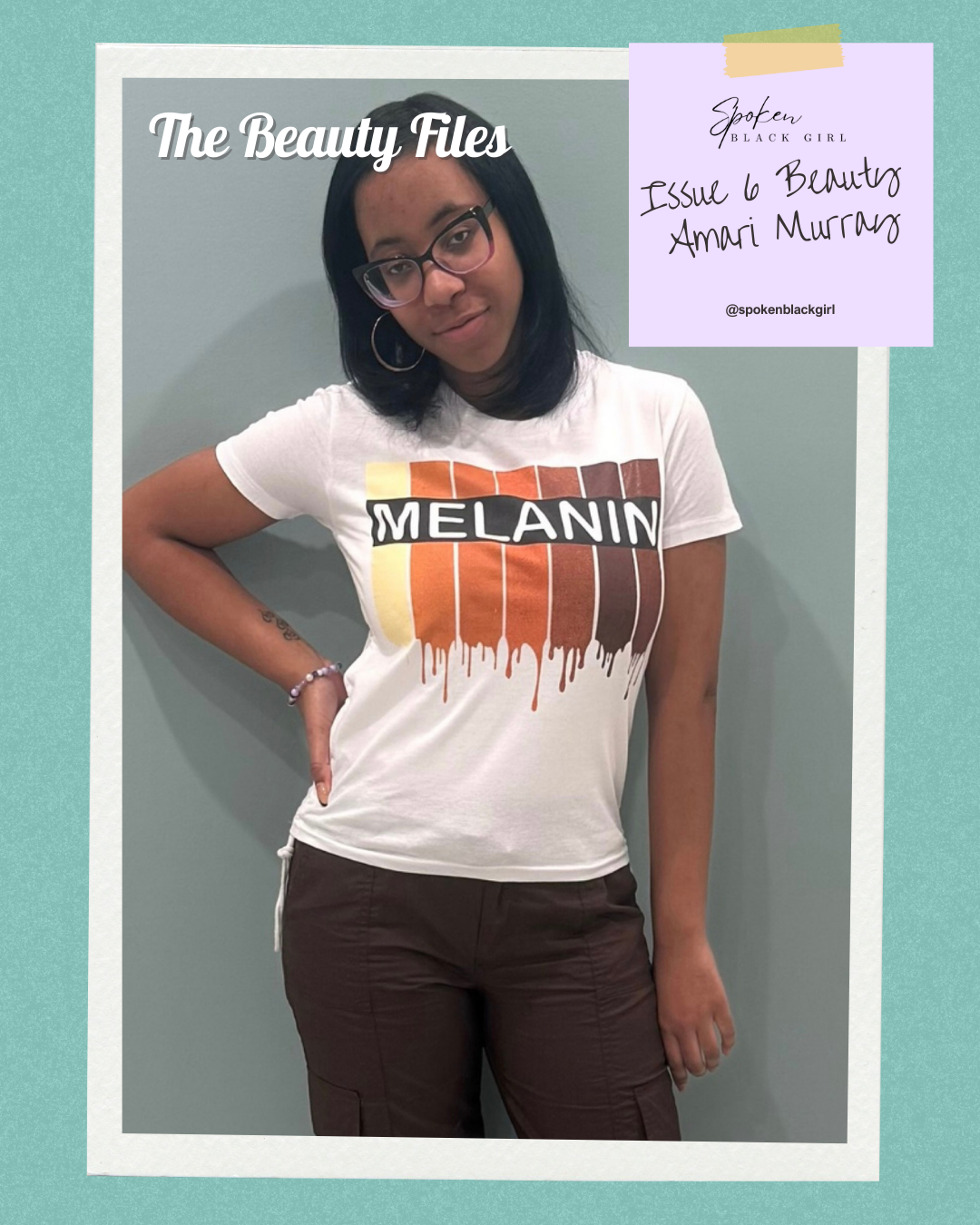
We’re back with a new installment of The Beauty Files, a series where we will uncover the behind the scenes stories of our Issue 6 Beauty Contributors and what they believe about beauty as Black women artists and creatives. Next up we have Spoken Black Girl Beauty Contributor, Amari Murray, whose poem “Braids in my Head” appears in Spoken Black Girl Issue 6 Beauty.
What inspired your piece featured in Spoken Black Girl: Beauty?
“Braids in my Head” was inspired by the specific act of getting my hair braided by my mother. I wanted to explore beauty not as something external or performative, but as something inherited, practiced, and passed down through touch, patience, and love. The piece honors hair as memory, language, and legacy.
Was there a specific moment, person, or experience that sparked your creative process for this piece?
Yes, the memories of as a little girl sitting between my mother’s knees as she braided my hair. That moment, so common yet sacred in black households stayed with me. The warmth of the room, the rhythm of her hands, the instruction to “keep still”, all of it shaped how I understand honor, care, love, and discipline. Creating this piece felt like revisiting that space of connection.
What role has writing, art, or creativity played in your self-expression and healing journey?
Writing has always been my way of naming myself and my experiences when words weren’t spoken aloud. Through poetry, I’ve been able to unpack my identity, memory, and belonging especially as a black woman. Creativity allows me to hold both tenderness and truth at once and in that balance I’ve found healing.
Which Black woman artist, writer, or thinker has most shaped your understanding of beauty?
Maya Angelou has proudly shaped my understanding of beauty. Through her work, she taught me that beauty is rooted in resilience, self-acceptance, and truth. Her words affirm that black womanhood is powerful, soft, and unapologetic all at once. She showed me that beauty is not about perfection, but about presence standing in who you are, honoring where you come from, and speaking your truth with grace. What music, books, or visual art inspired you during the creation of your piece?
How do you hope your work contributes to the larger conversation around beauty and Black womanhood?
The biggest thing I'm learning is to stop being hard on myself and give myself a break. The best part about being human is not being perfect, and I have to really wire my focus on that. There's beauty in rest. There is beauty in growth. There's beauty in trail and error. There's a beauty in failure because it can give you strength to try again and succeed. That is a conversation I hope my piece can start.
What would you tell a younger Black girl about beauty that you wish you’d known sooner?
I would tell her that beauty is not something you grow into it’s something you already carry. It lives in you, your hair, your history, and the people who loved you before you knew how to love yourself. You don’t need to rush, shrink, or change to be worthy. You already are.
How do you hope your work contributes to the larger conversation around beauty and Black womanhood.
I hope my work expands the definition of beauty to include memory, lineage, and care. Beauty lives in the hands that braid, the patience that teaches, and the legacy we carry forward. I want readers to recognize that black womanhood is not only seen it is felt, taught, and remembered.
More About Amari:
Amari Murray (she/her) is a poet from Brooklyn, New York. She holds a B.A. in Creative Writing from Purchase College, SUNY. She began writing poetry at the age of eight and later published her first poem, “Prayers For The Fear of Family Pandemics,” in high school. When she writes, it is drawn from her personal experiences, rooted in the dualities of pleasure and pain, silence and voice, intimacy and independence. Her work explores secrets, self-discovery, and survival through vivid imagery, layered emotion, and lyrical rhythm. Currently, she has completed her first poetry manuscript, which brings together love, betrayal, and healing into a powerful story about exposing the truth, the danger of silence, and the choice of how a woman reclaims herself. She has performed at the Bowery Poetry Club and Girls Write Now. Her work has appeared in the 2021 Girls Write Now Unmuted Print Anthology, Consortium COVID-19 Journal, UbuntuHarlem Magazine, and UN2RE: Telling Our Own Stories Digital Anthology with forthcoming publication in Quillkeepers Press and The Blunt Space.
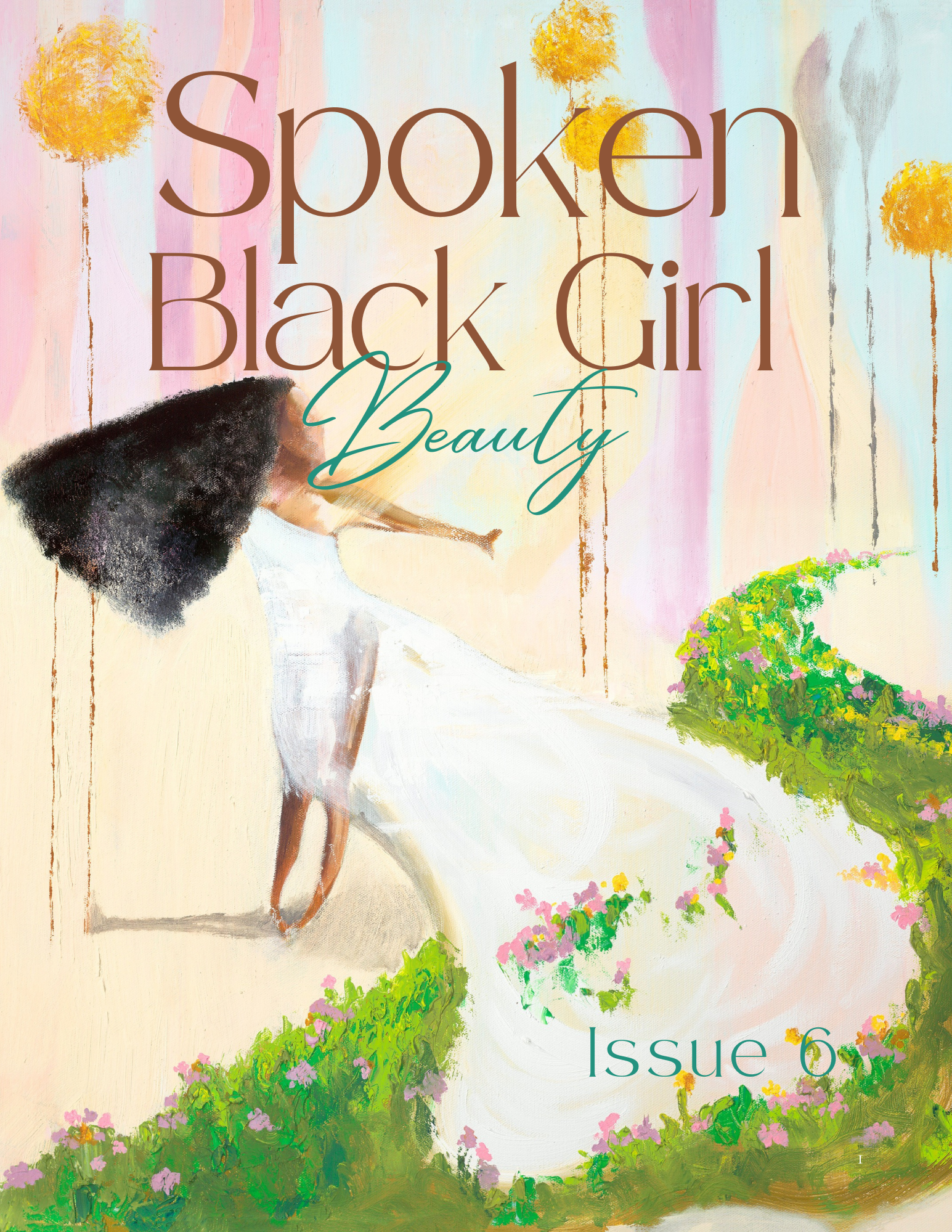
Spoken Black Girl Magazine: Issue 6 – Beauty is a radiant, full-color exploration of Black beauty rooted in self-love, authenticity and community. Weaving compelling mental health narratives with poetry and stunning visuals, Spoken Black Girl Issue 6 Beauty contains works that redefine beauty. Written, edited and curated by Black women and femmes, Spoken Black Girl Beauty offers a unique editorial viewpoint in which our beauty is the standard. Our Issue 6 cover features Solitude by Julie Atkinson.
Featured Issue 6 Beauty Contributors:
Adwoa Amponsah, Yewande Akinse, Julie Atkinson, Maroula Blades, Daisy Brown, Christie A. Cruise, Jada D'Antignac, Daniela Dampare, Kamaria Delaney, Elizabeth DeHaan, Crystal Foretia, Salisa L. Grant, Brandon LA Hutchinson, Yuki Jackson, Rev. Lotus La Loba, Michaela "Mikki" McKenzie, Brittney Miles, Amari Murray, Traci Neal, Adrienne Prather, Khalisa Rae, Karla M. Scipio, Kayla T., Chidera Udochukwu-Nduka, Afton Williams-Jacobs, Jasmine Williams-Jacobs, Maya Williams
Issue 6 Editors:
Editor-in-Chief: Rowana Abbensetts-Dobson, Guest Editor: Emelda De Coteau, Guest Editor: Jana Jones.
Highlights include:
✨ New contributor features alongside beloved returning writers and artists
🌿 The launch of the Spoken Black Girl Community Awards
💖 Resources on Safe Beauty Without Compromise
🎨 Full-color artwork that celebrates the brilliance of Black womanhood
Whether you’ve followed Spoken Black Girl from the beginning or are just joining our community, I hope you enjoy this issue.
All preorders will come with a special gift and be signed by Spoken Black Girl Editor-in-Chief, Rowana Abbensetts-Dobson
Publication Date: February 2, 2026
Format: Full-Color Print & Digital Edition
Publisher: Spoken Black Girl Publishing
Preorder now to reserve your copy and be part of this celebration of Black beauty and storytelling.
Full-color print copy of Spoken Black Girl Magazine: Issue 6 – Beauty
Ships in eco-friendly packaging with literary thank-you gifts inside
Publication Date: February 2, 2026
🌸 Every Purchase Supports
Your order helps Spoken Black Girl Publishing continue uplifting the voices of Black women writers and artists through storytelling, community, and healing.
